Software is dead. Long live software
Vibe coding has commodified engineering. When execution gets cheap, the definition of what is worth executing changes — and taste and trust become the scarce assets.
Keywordssoftware, agents, vibe coding, taste, SaaS
6 sections · 2707 words
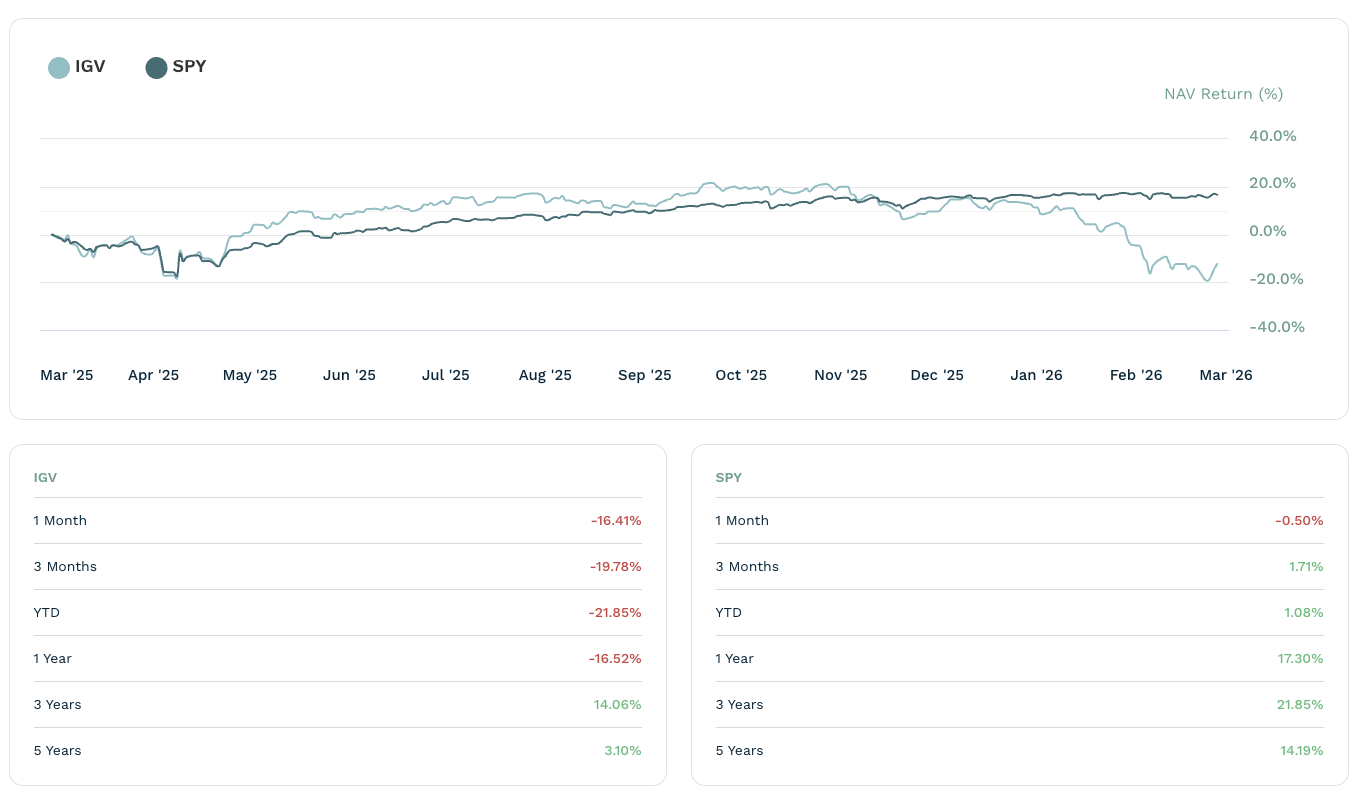 Public market valuations of IGV (mostly SaaS) versus S&P 500. Notice the divergence in the last 3 months. Source
Opus 4.5 marked the end of professional software engineering as we know it. The public markets seem to have caught up to that, with selloffs on the likes of Salesforce, Asana, DocuSign. Vibe coding commodifying engineering has generated fear amongst investors that all software is now up for grabs.
Ideas are cheap, execution is cheaper
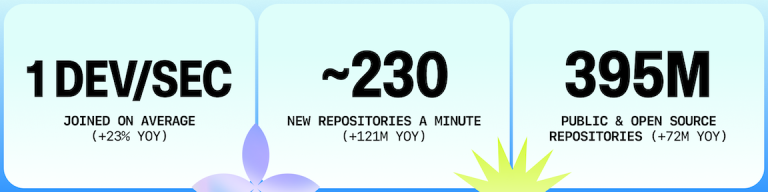 Github's 2025 stats. Source
In 2025, 36M developers joined Github - surpassing the average rate of 15-25M in the prior 5 years. According to them, nearly 80% of new developers use GitHub Copilot within their first week. If you have been a victim of my various weirdo digital "cards" over the last couple of years, you know that I wouldn't have been able to create those sans AI. The sim2real gap from idea to output used to be bridged by a combination of talent and craft; and increasingly both of those are diminishing in importance.
Asking founders "what makes this so hard to copy" or "why wouldn't Google do this" used to be scoffed at as a pedestrian low context finance bro question. It no longer is. One good idea almost immediately spawns an infinite number of shadcn ui clones. And Google has impressively caught up with the frontier labs with their recent model releases. Couple that with their treasure trove of private Google Workspace data (Gmail has 2.5B active users, vs 400M+ for Outlook), it actually makes them a credible threat that can't be easily shrugged off as "too big to compete".
Perhaps the scariest thing of all is that the tools are tooling themselves. Recursive self-improvement is only growing. Claude Code and Codex are their own authors, while OpenClaw bots build their own tools and update their own SOUL.mds. Your competition isn't just other human beans; it is the tireless, fast digital army said human beans generated that is rapidly reproducing beyond what their meatbag supervisors can reasonably supervise.
This existential dread is not new. In response to steam engines, Samuel Butler wrote (under the pseudonym Cellarius) in a 1863 letter to The Press, a daily newspaper:
...it appears to us that we are ourselves creating our own successors; we are daily adding to the beauty and delicacy of their physical organisation; we are daily giving them greater power and supplying by all sorts of ingenious contrivances that self-regulating, self-acting power which will be to them what intellect has been to the human race. In the course of ages we shall find ourselves the inferior race.
- Samuel Butler, Darwin Among the Machines
The residual is the art
When I began my physical studies [in Munich in 1874] and sought advice from my venerable teacher Philipp von Jolly...he portrayed to me physics as a highly developed, almost fully matured science...Possibly in one or another nook there would perhaps be a dust particle or a small bubble to be examined and classified, but the system as a whole stood there fairly secured, and theoretical physics approached visibly that degree of perfection which, for example, geometry has had already for centuries.
- Max Planck
But just because people are lamenting about proliferation and saturation doesn't mean it's true. When a new technological capability is unlocked, we are usually comparing it to our existing experiences. But that's like imagining VR games in the age of horse-drawn carriages. Samuel Butler certainly didn't have autonomous digital agents in his war cry against the machines. Kuhn, the man behind paradigm shifts, has an incommensurability thesis: that paradigms are fundamentally untranslatable to each other. His most well-developed example is the shift from Ptolemic geocentrism to the Copernican heliocentrism. If Copernicus was right that the Earth orbits the Sun, then we should be able to observe stellar parallax: stars should appear to shift position as we move from one side of our orbit to the other. But nobody could see any shift. For the Ptolemaic astronomers, this was proof that the Earth stood still. The Copernican answer - that stars are so unfathomably far away that the parallax is too small to detect - required imagining a cosmos orders of magnitude larger than anyone thought plausible. The firmament wasn't a ceiling just overhead. It was, effectively, infinite. Something that seemed laughable to believe at the time.
What a man sees depends both upon what he looks at and also upon what his previous visual-conceptual experience has taught him to see...No part of the aim of normal science is to call forth new sorts of phenomena; indeed those that will not fit the box are often not seen at all.
- Thomas Kuhn, Structure of Scientific Revolutions
What we can posit is that when execution gets cheap, the definition of what's worth executing changes. I am pretty certain that most people don't know what they want. Part of what you pay your {software} for is the product design itself. My mom certainly wouldn't have come up with the design of Notion or Instagram on her own. Henry Ford famously (and apocryphally) said that if he had asked people what they wanted, they would have said faster horses. Less apocryphally, Steve Jobs stated in a 1998 BusinessWeek interview:
It's really hard to design products by focus groups. A lot of times, people don't know what they want until you show it to them.
A 2010 study set up a tasting venue and invited passerby shoppers to sample two types of jam or tea and state their preference. After participants made their choice, they were asked to sample their choice and explain it - but the researchers had switched the contents, and participants were tasting the jar they rejected. Only a third or less of the trials were detected. What great product design does is make latent desire legible. It has just been decoupled from the skills needed for execution.
A few friends and I were talking about subversion in art over dinner. I brought up The Age of Average, which back in 2023 bemoaned how everything was converging to the same sameness. Makeup, AirBnB decor, book covers, Instagram posts. But he concludes on a hopeful note that this sameness only makes deviations so much more distinct. Being able to pry yourself away from the homogeneous norm is part of what makes subversion salient.
I believe that the age of average is the age of opportunity.
When every supermarket aisle looks like a sea of sameness, when every category abides by the same conventions, when every industry has converged on its own singular style, bold brands and courageous companies have the chance to chart a different course. To be different, distinctive and disruptive.
So, this is your call to arms. Whether you're in film or fashion, media or marketing, architecture, automotive or advertising, it doesn't matter. Our visual culture is flatlining and the only cure is creativity.
It's time to cast aside conformity. It's time to exorcise the expected. It's time to decline the indistinguishable.
For years the world has been moving in the same stylistic direction. And it's time we reintroduced some originality.
Or as the ad agency BBH says.
When the world zigs. Zag.
- Alex Murrell, The Age of Average
Are incumbents asSaaSsinated?
On the other hand, though... if anybody can build-your-own-bear, should we be holding a wake for all software incumbents?
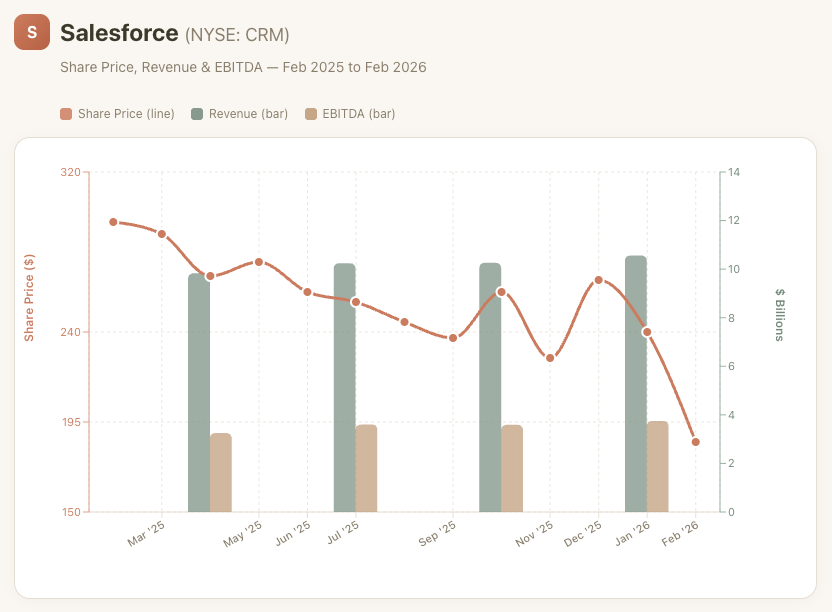 not community-adjusted
The question of is Salesforce dead is coming up often. What comes up less often is the $24B Salesforce ecosystem - the implementation and integration services to pinch and pull Salesforce into the specific quirk of their enterprise clientele. That's a significant chunk of Salesforce's revenue itself (~$40B est for 2026). The official list is over 3K+ partners, and there are thousands more off it. >50% revenue that Salesforce isn't capturing. Why?
The hardest part isn't the software; it is organizational translation. Turning messy, political, cross-department processes into structured logic. The stint I had as a BCG consultant included trying to support IT tool development for a telco in the Philippines, and god help me the number of stakeholder management meetings required. Different teams ask or optimize for different things, and trying to stitch all of them together changes the budget or development timelines or features or all of the above, which then triggers a vicious cycle of having to go back to stakeholders with the renewed requirement list, launching a new set of negotiations... and so on and so forth. OpenAI's Frontier push partnering with my former employer and its peers is signal that code generation in and of itself is insufficient.
Your beautiful vibe coded platform that may or may not be better than Apex-built interfaces, but that's not enough to have the board of a multi-billion dollar telecommunications provider open their doors for you. The intangible layer on top of product and technology has a lot more in common with why corporations shell out millions of dollars to have 23-year-olds present powerpoint slides to them: trust. Strip these unformed-prefrontal-cortex'ed consultants of their McKinsey logos (i.e. me a decade ago), and suddenly they are much less interesting for grey beards to listen to.
Here's a counterpoint: Salesforce FY26 revenue of $41.5B is +10% vs last year (they grew +9% the year before), and their Agentforce ARR is now $800M, 2.7x vs last year; implying slowing growth in core products that is netting off the faster AI revenue trajectory. So yes, AI is eating software, but it is dollars sloshing around the same trusted provider.
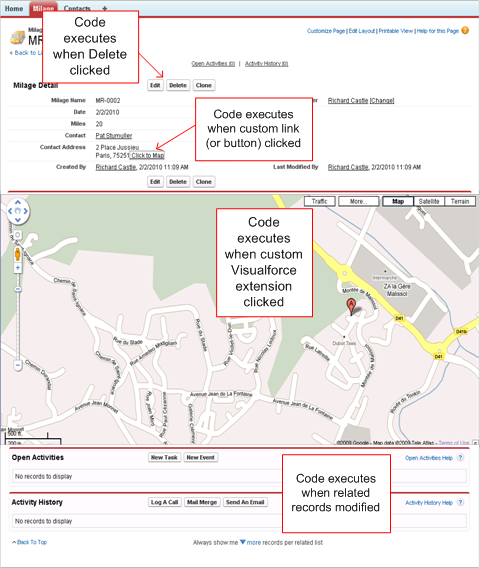 Look at those mid-2000s skeumorphic buttons from the (current) Apex docs. Brings me back.
I think there are two vectors for trust: liability transfer, and identity signifier.
The first matters when there is asymmetric error cost. The cost of an error in the "dangerous" transaction is far greater than the cost of an error in the "safe" direction. i.e. downside protection matters more than upside management. You'll see folks yeeting end-to-end AI-generated notetakers, calendar schedulers, and diet apps. You'll see far fewer copies of Chase, Gusto, Stripe, Turbo Tax. For example, with Stripe: if you block a legitimate transaction (false positive), the customer gets annoyed, maybe drops off. You lose the margin you would have had on that transaction (usually 1-3%). But if you allow fraud to come through (false negative), you eat the chargeback - 100% of the transaction. In enterprises, that also matters at the individual level: does this stakeholder get fired if something goes wrong, or can they blame the vendor? That, in my opinion, is the underlying fuel for corporate bureaucracy. Anything that manages risks around money and regulations will be much harder to unseat.
The latter is probably what most people think of when they think of brand. But I would unpack that a little further. Sometimes, brand is an information compression heuristic that reduces the buyer's search cost. You skip the step of "does this work" or "will this taste good" because the brand becomes a stamp of quality on that product. Brand additionally has another function: a badge of affiliation that becomes social coordinates for taste, status, values, tribe. Take for example the sparkling water factions of Le Croix versus Spindrift versus Liquid Death that suggest you are {x} kind of person according to your choice of carbonated H2O. If your company owns a brand people want to be associated with, that might have gravitational pull over and above the actual product itself. You might think this matters more with consumers than with enterprises - but the corporate version of this is qualitative signaling to your boss/board/shareholders. Even if agents erode the brand-in-lieu-of-research by being able to well, conduct that research, it doesn't go away completely, especially in the eyes of the person paying you / able to fire you.
The prediction I'm trying to make here is that Claude Code and Codex (why are they all C's??) is necessary but insufficient to topple Salesforce overnight. Its anchor is the trust built upon their partners' track record with enterprises. The first domino to fall has to be that ecosystem, before the slingshot reaches that Goliath, and I think AI makes their work faster and cheaper, not redundant. I'm not saying that it won't happen, but I think it will percolate at a slower pace than AGI bulls think. Computerization took about two decades, as is shifting to cloud (which isn't complete yet!). I don't think AI skips this step entirely, even if it might be blazing through it much faster.
Trust is an asset that compounds
Packy McCormick wrote a great piece on Power in the Age of Intelligence. He similarly identified regulatory complexity as a potential moat, or at least a barrier to entry. And... it doesn't explain why Stripe ($159B) is so much larger than Adyen ($34B), or Ramp ($32B) versus Brex (acquired at $5B a couple months ago). His answer is in the Schwerpunkt, or scarce asset that could unlock constraints in a sector, and owning it. So in this context of the SaaSpocalypse, the more delta there is between the trust versus untrusted providers, the more rare and therefore valuable trust becomes. Why does it take a long time to sell to enterprises? Going through their myriad stakeholders, fending off legal redlines as you trudge through their procurement processes, are all ways your customer is attempting to find proxies for trust.
Cognitive science has a Bayesian brain hypothesis (Cognee is also inspired by this in their "smart" part of smart memory) that proposes that the brain maintains probabilistic models of the world, continuously updating its beliefs as new evidence arrives. Building trust is not an on/off switch, but a probability distribution conditioned on priors.
These have a couple of implications in how you build that trust:
- Priors are not zero. Customers don't have zero trust, but a weakly informative prior shaped by signals, referrals, context, analogies, etc. This is why the first impression helps a lot, such as social proof and warm intros, as it helps shift the starting prior in your favour.
- Consistency matters. Early in a relationship, the distribution is wide. As the customer doesn't know what to expect, each experience carries outsized weight. Over time, consistent delivery of performance tightens that distribution. Given the above, high-precision priors (where they have high confidence in your delivery) are very hard to move, which is why newcomers need to be significantly better to nudge people out of their pre-existing behaviors and uncertainty management. The brain tracks prediction errors, the gap between expectations versus reality, so high variance - even in a positive direction - can be less trust-building than reliable outputs.
- Updates are asymmetric. Negative evidence gets weighted more heavily than positive evidence of equal magnitude. This was shown in a 2002 paper in the context of individuals responding to negative versus positive news in the nuclear power industry or the food supply industry, in a 2023 paper showing asymmetric impact on trust based on experiential information, and in one in the context of how multiple human-robot trust violations seem irreparable.
In the above article, McCormick also talks about how winners are increasingly taking more; power and wealth is concentrating into an ever diminishing denominator. What Salesforce has in its favour is 20 years of Bayesian evidence that has deepened the prior that, again, needs spectacular competency differentials to challenge.
Be the change you want to see
So: build. If taste and trust are the scarce assets, the opportunity cost of not building has gone up. Vibe coding means the first 80% of a product is virtually free; and the last 20% - the part that earns trust, that gets users to realize they have always wanted this thing but never had the words for it - is the real contested last mile.
The stars aren't attached to a firmament. Cars are a different beast from, well, beasts. We don't know what the next paradigm's inventions, and products, and companies look like. The only way to know is to make it.